Scaling Green Without Grinding to a Halt: A Practical Playbook for Mid-Market Companies Navigating Sustainability and Speed
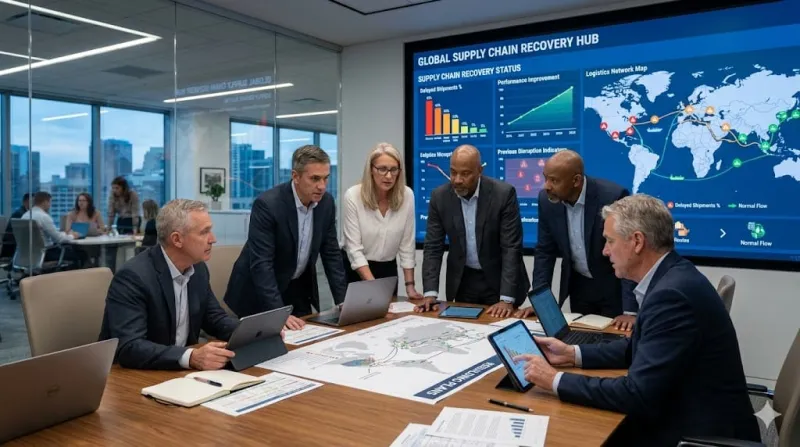
Photo: mid-market business team sustainability strategy supply chain operations meeting, via bunny-wp-pullzone-btfvypgk6i.b-cdn.net
The mid-market growth phase is a particular kind of operational pressure cooker. Revenue is expanding. Headcount is climbing. New markets are opening. And somewhere in the middle of all that momentum, someone in a leadership meeting raises the sustainability program — and the room gets complicated.
For companies that built their environmental commitments when they were smaller and simpler, rapid growth exposes a structural problem that rarely makes it into the sustainability report: the systems designed to enforce green standards were never engineered to scale. The result is a creeping operational friction that affects procurement lead times, supplier onboarding, product launch cycles, and cross-functional alignment. Well-intentioned sustainability requirements begin to function less like strategic assets and more like institutional drag.
This is not a reason to retreat from environmental accountability. It is a reason to rebuild how that accountability is architected.
How Sustainability Becomes a Bottleneck
The friction typically begins at procurement. A mid-market manufacturer, distributor, or services company implements a supplier sustainability screening process — questionnaires, certifications, third-party audits — that works reasonably well when the supplier base is stable and volume is predictable. As the company grows, new suppliers are needed faster, existing suppliers are asked to expand into new categories, and the screening process that once took two weeks now takes six. Procurement teams begin routing around the process, or the process becomes a checkbox exercise that no longer reflects actual supplier performance.
Metric conflicts compound the problem. The sustainability team is tracking carbon intensity per unit of revenue. The operations team is tracking cost per unit shipped. The product team is tracking time-to-market. When a decision requires trade-offs among these dimensions — as most consequential decisions do — there is no shared framework for resolving the conflict. Each team optimizes for its own metrics, and sustainability requirements are frequently the variable that gets sacrificed when timelines compress.
Compliance overhead adds another layer. As sustainability regulations tighten at the state and federal level — California's climate disclosure requirements, evolving EPA reporting obligations, SEC climate risk rules still working their way through the regulatory environment — mid-market companies are absorbing compliance demands that were previously the exclusive concern of large public corporations. Many are doing so without the dedicated legal, compliance, or reporting infrastructure that large enterprises have built over decades.
The cumulative effect is an organization that has made genuine commitments to environmental performance but finds itself unable to honor them at scale without paying a significant operational price.
The Root Cause: Sustainability Bolted On, Not Built In
Most of the operational friction described above traces to a single architectural decision made early in a company's sustainability journey: environmental accountability was added to existing systems rather than integrated into the design of those systems.
A procurement process designed for speed and cost optimization, modified to include sustainability screening, will always produce tension between those objectives. A product development process optimized for time-to-market, with sustainability requirements appended at the approval stage, will consistently generate late-stage conflicts that delay launches or compromise environmental standards.
The companies that successfully scale green operations do not manage this tension by finding the right balance between sustainability and speed. They eliminate the tension by redesigning their core operating processes so that environmental criteria are embedded from the outset — not added downstream.
This requires a different kind of organizational investment than most sustainability programs contemplate. It is less about policies and more about process architecture. Less about reporting frameworks and more about decision infrastructure.
A Playbook for Scalable Green Operations
Rebuild Procurement Around Tiered Environmental Standards
Not every supplier relationship carries the same environmental risk or strategic significance. A scalable procurement sustainability program differentiates between tiers. Tier one suppliers — those representing the highest spend, greatest emissions exposure, or most significant reputational risk — warrant rigorous, ongoing environmental performance management. Tier two and three suppliers can be managed through lighter-touch mechanisms: standardized questionnaires, industry certification equivalencies, or periodic spot audits.
This tiered approach preserves the rigor where it matters most while dramatically reducing the compliance overhead that slows onboarding for lower-risk suppliers. It also creates a clear pathway for suppliers to move between tiers as the relationship evolves, incentivizing improvement without creating administrative barriers to entry.
Establish a Unified Environmental Performance Metric
Organizations that struggle with cross-functional metric conflicts typically lack a single, authoritative environmental performance indicator that all teams are required to optimize against. Without one, each department defaults to the metrics most relevant to its own function — and sustainability loses the argument whenever it conflicts with cost or speed.
The solution is to establish a primary environmental metric — absolute Scope 1 and 2 emissions, emissions intensity per dollar of gross profit, or a composite score weighted to the company's specific material impacts — and embed it in the decision criteria used by every function. This does not mean that cost and speed are irrelevant. It means that any decision to trade off environmental performance against other objectives is made explicitly and with appropriate authorization, rather than by default at the departmental level.
Design Compliance Infrastructure Ahead of the Regulatory Curve
Mid-market companies that wait until regulatory requirements are finalized before building compliance infrastructure consistently find themselves absorbing the cost of rushed implementation. The trajectory of U.S. sustainability disclosure and reporting requirements is clear enough — even amid regulatory uncertainty — that forward-looking organizations can begin building the data collection, verification, and reporting systems they will eventually need.
This is not a call for speculative investment. It is a recognition that the marginal cost of building environmental data infrastructure incrementally, as part of ongoing systems development, is substantially lower than the cost of retrofitting it under regulatory deadline pressure. Companies that treat compliance infrastructure as a strategic asset — rather than a reactive obligation — gain a meaningful operational advantage as requirements tighten.
Create Cross-Functional Sustainability Integration Roles
One of the most persistent sources of operational friction in mid-market sustainability programs is the gap between the sustainability team and the operational functions responsible for executing strategy. Sustainability professionals with deep environmental expertise frequently lack the operational authority or organizational relationships to influence procurement, product development, or logistics decisions in real time.
Building explicit integration roles — sustainability liaisons embedded in procurement, operations, and product teams — bridges this gap without requiring a wholesale reorganization. These roles are responsible not for enforcing compliance but for translating environmental objectives into operationally actionable guidance and surfacing emerging conflicts before they become launch-delaying crises.
Speed and Sustainability Are Not Opposites
The companies most likely to lose competitive ground on sustainability are not those that move too fast. They are those that allow the operational friction of poorly integrated environmental programs to produce a false choice between growth and accountability.
Scalable green operations require deliberate architectural investment — in process design, in shared metrics, in forward-looking compliance infrastructure, and in the organizational relationships that allow sustainability criteria to influence decisions in real time. That investment is not free. But the cost of making it proactively is substantially lower than the cost of managing a sustainability program that grows more dysfunctional with every point of revenue expansion.
Growth is not the enemy of environmental accountability. Poorly designed systems are.